


Page 61 - Across the Andes: Chile’s Atacama Desert & Argentina’s Northwest
P. 61
•  Time Zone: Argentina time (ART) is 3 hours behind Coordinated Universal Time.
                    Generally Argentina is 1 hour ahead of Eastern Time in the U.S. So usually, when it is
                    6am in Washington D.C. it is 7am in Buenos Aries. But Argentina doesn’t use daylight
                    ^LaTYR _TXP WTVP _SP @ >  OZP^  ^Z Q]ZX 9ZaPXMP] _Z 8L]NS _SP]P T^ L   SZ`] OTʬP]PYNPɨ
                    6am in D.C. is 8am in Buenos Aires.

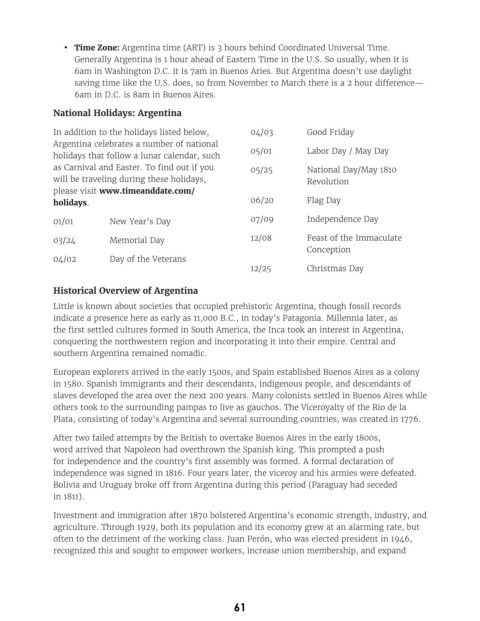
               National Holidays: Argentina

               In addition to the holidays listed below,         04/03         Good Friday
               Argentina celebrates a number of national
                                                                 05/01         Labor Day / May Day
               holidays that follow a lunar calendar, such
               L^ .L]YTaLW LYO 0L^_P]  ?Z ʭYO Z`_ TQ dZ`         05/25         National Day/May 1810
               will be traveling during these holidays,                        Revolution
               please visit www.timeanddate.com/
               holidays.                                         06/20         Flag Day

               01/01         New Year’s Day                      07/09         Independence Day

               03/24         Memorial Day                        12/08         Feast of the Immaculate
                                                                               Conception
               04/02         Day of the Veterans
                                                                 12/25         Christmas Day


               Historical Overview of Argentina
               Little is known about societies that occupied prehistoric Argentina, though fossil records
               indicate a presence here as early as 11,000 B.C., in today’s Patagonia. Millennia later, as
               _SP ʭ]^_ ^P__WPO N`W_`]P^ QZ]XPO TY >Z`_S ,XP]TNL  _SP 4YNL _ZZV LY TY_P]P^_ TY ,]RPY_TYL
               conquering the northwestern region and incorporating it into their empire. Central and
               southern Argentina remained nomadic.

               European explorers arrived in the early 1500s, and Spain established Buenos Aires as a colony
               in 1580. Spanish immigrants and their descendants, indigenous people, and descendants of
               slaves developed the area over the next 200 years. Many colonists settled in Buenos Aires while
               others took to the surrounding pampas to live as gauchos. The Viceroyalty of the Rio de la
               Plata, consisting of today’s Argentina and several surrounding countries, was created in 1776.

               After two failed attempts by the British to overtake Buenos Aires in the early 1800s,
               word arrived that Napoleon had overthrown the Spanish king. This prompted a push
               QZ] TYOP[PYOPYNP LYO _SP NZ`Y_]dɪ^ ʭ]^_ L^^PXMWd bL^ QZ]XPO  , QZ]XLW OPNWL]L_TZY ZQ
               independence was signed in 1816. Four years later, the viceroy and his armies were defeated.
               -ZWTaTL LYO @]`R`Ld M]ZVP Zʬ Q]ZX ,]RPY_TYL O`]TYR _ST^ [P]TZO  ;L]LR`Ld SLO ^PNPOPO
               in 1811).

               Investment and immigration after 1870 bolstered Argentina’s economic strength, industry, and
               agriculture. Through 1929, both its population and its economy grew at an alarming rate, but
               often to the detriment of the working class. Juan Perón, who was elected president in 1946,
               recognized this and sought to empower workers, increase union membership, and expand


                                                             61

