


Page 84 - Ancient Kingdoms: Thailand, Laos, Cambodia & Vietnam
P. 84
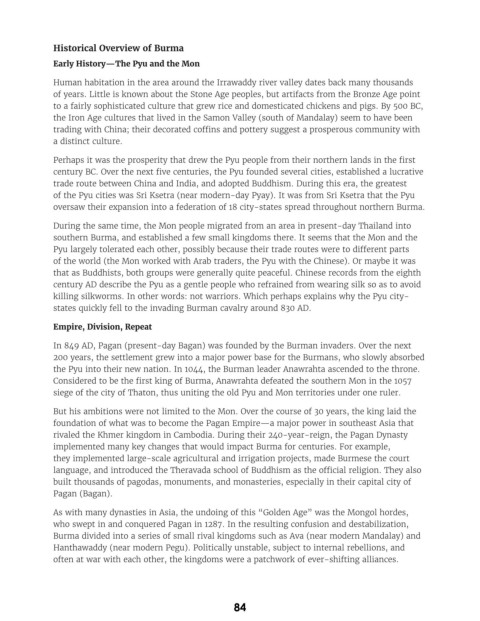
Historical Overview of Burma

               Early History—The Pyu and the Mon
               Human habitation in the area around the Irrawaddy river valley dates back many thousands
               of years. Little is known about the Stone Age peoples, but artifacts from the Bronze Age point
               to a fairly sophisticated culture that grew rice and domesticated chickens and pigs. By 500 BC,
               the Iron Age cultures that lived in the Samon Valley (south of Mandalay) seem to have been
               _]LOTYR bT_S .STYL& _SPT] OPNZ]L_PO NZʯY^ LYO [Z__P]d ^`RRP^_ L []Z^[P]Z`^ NZXX`YT_d bT_S
               a distinct culture.

               ;P]SL[^ T_ bL^ _SP []Z^[P]T_d _SL_ O]Pb _SP ;d` [PZ[WP Q]ZX _SPT] YZ]_SP]Y WLYO^ TY _SP ʭ]^_
               NPY_`]d -.  :aP] _SP YPc_ ʭaP NPY_`]TP^  _SP ;d` QZ`YOPO ^PaP]LW NT_TP^  P^_LMWT^SPO L W`N]L_TaP
               trade route between China and India, and adopted Buddhism. During this era, the greatest
               of the Pyu cities was Sri Ksetra (near modern-day Pyay). It was from Sri Ksetra that the Pyu
               oversaw their expansion into a federation of 18 city-states spread throughout northern Burma.

               During the same time, the Mon people migrated from an area in present-day Thailand into
               southern Burma, and established a few small kingdoms there. It seems that the Mon and the
               ;d` WL]RPWd _ZWP]L_PO PLNS Z_SP]  [Z^^TMWd MPNL`^P _SPT] _]LOP ]Z`_P^ bP]P _Z OTʬP]PY_ [L]_^
               of the world (the Mon worked with Arab traders, the Pyu with the Chinese). Or maybe it was
               that as Buddhists, both groups were generally quite peaceful. Chinese records from the eighth
               century AD describe the Pyu as a gentle people who refrained from wearing silk so as to avoid
               killing silkworms. In other words: not warriors. Which perhaps explains why the Pyu city-
               states quickly fell to the invading Burman cavalry around 830 AD.


               Empire, Division, Repeat
               In 849 AD, Pagan (present-day Bagan) was founded by the Burman invaders. Over the next
               200 years, the settlement grew into a major power base for the Burmans, who slowly absorbed
               the Pyu into their new nation. In 1044, the Burman leader Anawrahta ascended to the throne.
               .ZY^TOP]PO _Z MP _SP ʭ]^_ VTYR ZQ -`]XL  ,YLb]LS_L OPQPL_PO _SP ^Z`_SP]Y 8ZY TY _SP    "
               siege of the city of Thaton, thus uniting the old Pyu and Mon territories under one ruler.

               But his ambitions were not limited to the Mon. Over the course of 30 years, the king laid the
               foundation of what was to become the Pagan Empire—a major power in southeast Asia that
               rivaled the Khmer kingdom in Cambodia. During their 240-year-reign, the Pagan Dynasty
               implemented many key changes that would impact Burma for centuries. For example,
               they implemented large-scale agricultural and irrigation projects, made Burmese the court
               WLYR`LRP  LYO TY_]ZO`NPO _SP ?SP]LaLOL ^NSZZW ZQ -`OOST^X L^ _SP ZʯNTLW ]PWTRTZY  ?SPd LW^Z
              built thousands of pagodas, monuments, and monasteries, especially in their capital city of
              Pagan (Bagan).

              As with many dynasties in Asia, the undoing of this “Golden Age” was the Mongol hordes,
              who swept in and conquered Pagan in 1287. In the resulting confusion and destabilization,
              Burma divided into a series of small rival kingdoms such as Ava (near modern Mandalay) and
              Hanthawaddy (near modern Pegu). Politically unstable, subject to internal rebellions, and
              often at war with each other, the kingdoms were a patchwork of ever-shifting alliances.


                                                             84

